



Most hockey organizations place a jersey order and receive the finished product without ever thinking about what happens in between. The design goes in. Weeks pass. Then the jerseys come out. What takes place across those weeks — the decisions made, the processes followed, the quality standards applied — determines whether the finished product is something players are proud to wear or something that disappoints from the first game of the season.
Understanding the manufacturing process behind custom hockey jerseys gives organizations a genuine advantage. It helps them ask better questions before choosing a supplier. It also helps them prepare artwork and roster information correctly. Furthermore, it helps them understand why lead times exist, why design proof reviews matter, and why a supplier’s internal quality control affects the outcome of every order they place.
At VMF Sportswear, we manufacture premium custom hockey jerseys for organizations across Toronto, Ontario, and Canada. We manage every stage of the process in-house — from the first design concept through to the final packaged shipment leaving our facility. Through that direct manufacturing experience, we have developed a clear and thorough understanding of what each stage involves and why it matters. This guide walks through the complete process so your organization knows exactly what to expect.
Stage 1: Design Consultation and Concept Development
Understanding the Organization’s Identity
Every custom hockey jersey manufacturing process starts with a design consultation. Before any design work begins, the manufacturing team needs to understand the organization placing the order. What colours represent the team, and which logo will carry its visual identity? Equally important is the design style that best reflects who the organization is and how it wants to be seen.
These questions matter because the answers shape every design decision that follows. A jersey designed without this foundation tends to look generic — borrowed from a template rather than built for a specific team. In contrast, a jersey developed through a genuine design consultation reflects the organization’s real identity. Players recognize themselves in it. Furthermore, opponents and spectators recognize the team in it — which is exactly what a strong uniform achieves.
Gathering Design Assets and References
Once the design direction is clear, the manufacturing team gathers the assets needed to build it. This includes the team logo in vector format — AI, EPS, or PDF — which scales to any size without losing quality. It also includes team colour references in hex or Pantone codes, any sponsor logos to incorporate, and any existing design elements the organization wants to carry forward from previous seasons.
Submitting assets in the correct format at this stage saves significant time later. Raster files like JPG or PNG do not scale cleanly for jersey production. Reworking them adds days before the design process can begin. Therefore, confirming file requirements with the manufacturer before submitting artwork is one of the most practical steps an organization can take to keep the process moving efficiently from the very start.
Stage 2: Design Development and Digital Proofing
Building the Jersey Design From the Ground Up
With assets in hand and direction confirmed, the design team builds the jersey design. This means laying out every visual element across a technical jersey template — front, back, and sleeves — in the correct proportions and positions for production. The team logo sits at the correct size on the chest. Player names and numbers use the confirmed font style. Colour fills, stripe patterns, graphic elements, and sponsor logo placement all take their final positions at this stage.
For sublimated jerseys, this stage also involves mapping design elements across the full garment as a continuous piece of artwork. Sublimation allows full-panel design — graphics can flow seamlessly from the front panel across the sides and onto the sleeves without seam breaks. Consequently, the design team needs to account for how every element looks not just flat on screen but three-dimensionally on the finished jersey when a player wears it during competition.
The Design Proof Review Process
Once the design team completes the initial layout, the manufacturer sends a detailed design proof to the organization for review. This proof shows every element of the jersey design — colours, logos, names, numbers, stripe positions, and sponsor placement — exactly as they will appear on the finished garment. The organization reviews every element and either approves the design or requests specific changes.
This review stage is the most important checkpoint in the entire manufacturing process. Catching an error at the proof stage costs nothing to correct, while catching it after production begins costs real money and real time to fix. Therefore, organizations should involve every relevant stakeholder in the proof review before giving final approval. A thorough and unhurried proof review consistently prevents the most common and most frustrating post-production problems.
Stage 3: Pre-Production Preparation
File Preparation for Production
Once the organization approves the design proof, the manufacturing team prepares the files for production. This involves converting the approved design into production-ready file formats and confirming colour profiles match the production system’s requirements. Individual player details — names, numbers, and sizes — also enter the production workflow at this stage. Each player’s customization data links to their specific garment so the correct name and number reaches the correct size without error.
File preparation also involves checking that all design elements reproduce correctly at production scale. Colours need to match the approved references within acceptable tolerances. Fine logo details need to reproduce clearly at jersey size. Furthermore, elements close to seam positions need repositioning to ensure they do not cross seam lines in a way that disrupts the design’s appearance on the finished garment.
Fabric Selection and Material Preparation
At the pre-production stage, the manufacturing team confirms the fabric selection for the order. For sublimated jerseys, the base fabric is a performance polyester engineered to receive sublimation ink evenly and produce accurate colour reproduction across the full garment. Pro stitched jerseys instead use fabric selected for construction requirements and the decoration method applied.
The team checks fabric rolls for consistency before cutting begins. Colour uniformity, weight, stretch performance, and surface quality all require verification at this stage. As a result, the team identifies and resolves any fabric defects before they enter production — preventing finished jersey defects that would require remaking individual items at a later stage.
Stage 4: Sublimation Printing and Decoration
How Sublimation Printing Works
Sublimation printing is the decoration method the team uses for the majority of modern custom hockey jerseys. The process transfers colour and graphics from printed transfer paper into the polyester fabric fibres using heat and pressure. At the correct temperature, the dye converts from a solid to a gas and bonds permanently with the polyester fibres. Once the garment cools, the dye returns to a solid state — now locked inside the fabric rather than sitting on its surface.
This permanent bond gives sublimated custom hockey jerseys their durability advantages over surface-applied decoration methods. The design becomes part of the fabric itself. It cannot crack, peel, or fade regardless of how many times the jersey goes through the wash. Furthermore, because the dye penetrates the full surface of the fabric, the jersey retains its lightweight feel — the decoration adds no texture, no weight, and no stiffness to the finished garment.
Pro Stitching and Embroidery Application
For pro stitched jerseys, the decoration process works differently. The team cuts lettering, numbers, and crests from twill material or embroiders them and then sews them directly onto the jersey fabric. Precise placement is critical — each element needs to sit at exactly the correct position and angle before the sewing machine applies it permanently to the garment.
Embroidered crests go through a separate digitizing process before application. The design converts into stitch data that the embroidery machine reads and executes in the correct thread colours, stitch types, and density. This produces a premium raised finish that many competitive leagues and experienced players associate with top-level hockey apparel. Moreover, pro stitched decoration lasts through many seasons of competition — the sewn attachment holds strongly even under the physical demands of aggressive play and frequent washing.
Stage 5: Cutting, Sewing, and Garment Assembly
Pattern Cutting and Panel Preparation
For sublimated jerseys, cutting happens after the sublimation print process. The team cuts printed fabric panels according to the jersey pattern — front panels, back panels, sleeves, collar sections, and any additional design panels. Each panel cuts to the precise dimensions required for the specific size in each player’s order. Cutting accuracy at this stage directly affects how the design elements align across seams on the finished jersey. Poor cutting produces misaligned stripes, off-centre logos, and uneven sleeve designs that undermine the professional appearance of the finished garment.
Sewing and Assembly
The sewing stage assembles the cut panels into the finished jersey. Side seams, shoulder seams, sleeve attachments, collar construction, and hem finishing all take place here. Quality custom hockey jerseys use reinforced stitching at stress points — the shoulder seams, underarm seams, and side panels that absorb the most physical pressure during play. These reinforcements prevent seam failures that would otherwise occur early in a demanding season.
In-Process Quality Checks During Assembly
Quality control checks take place throughout the sewing process rather than only at the end. Each operator checks their own work before passing the garment to the next stage. Consequently, defects that arise early in the assembly process get identified and corrected immediately. This approach prevents defects from accumulating through subsequent stages and producing a finished jersey that requires remaking entirely.
Stage 6: Quality Control and Final Inspection
Checking Every Jersey Before Packaging
Every jersey goes through a final quality inspection before the team packages and ships it. This inspection checks colour accuracy against the approved design proof, design element positioning across every panel, seam integrity at all stress points, correct player name and number application, label accuracy for size and player identification, and overall garment presentation. Any jersey that does not meet the required standard gets set aside for correction or replacement — not packaged and shipped.
Individual Labelling and Organized Packaging
After passing inspection, each jersey receives a label matching it to the correct player name and size. The team then organizes packaging so the receiving organization can distribute jerseys to players quickly and accurately without sorting through an unlabelled bulk shipment. Furthermore, the team packs jerseys in a way that protects them during transit — preventing sharp folds or compression damage to sublimated panels that could affect appearance on arrival.
How VMF Sportswear Manages the Full Manufacturing Process
Every Stage Handled In-House
VMF Sportswear manages every stage of the custom hockey jersey manufacturing process in-house. Design consultation and digital proofing connect directly to sublimation printing, garment assembly, quality inspection, and domestic delivery across Canada. Our integrated manufacturing operation means every stage connects directly to the next without gaps or handoffs. The design team, production team, and quality control team all work under one roof. Consequently, colour accuracy, design integrity, and garment quality stay consistent from the first jersey in the order to the last.
Direct Manufacturing Advantages for Canadian Organizations
Canadian hockey organizations that work directly with VMF Sportswear benefit from the full range of direct manufacturing advantages — no intermediaries, no outsourced production uncertainty, and no communication gaps between design and manufacturing. Every decision affecting the finished jersey goes through our team directly. Furthermore, our domestic Canadian operation means reliable production timelines and shipping without the customs delays and border uncertainties that international suppliers introduce.
The Complete Custom Hockey Jersey Range
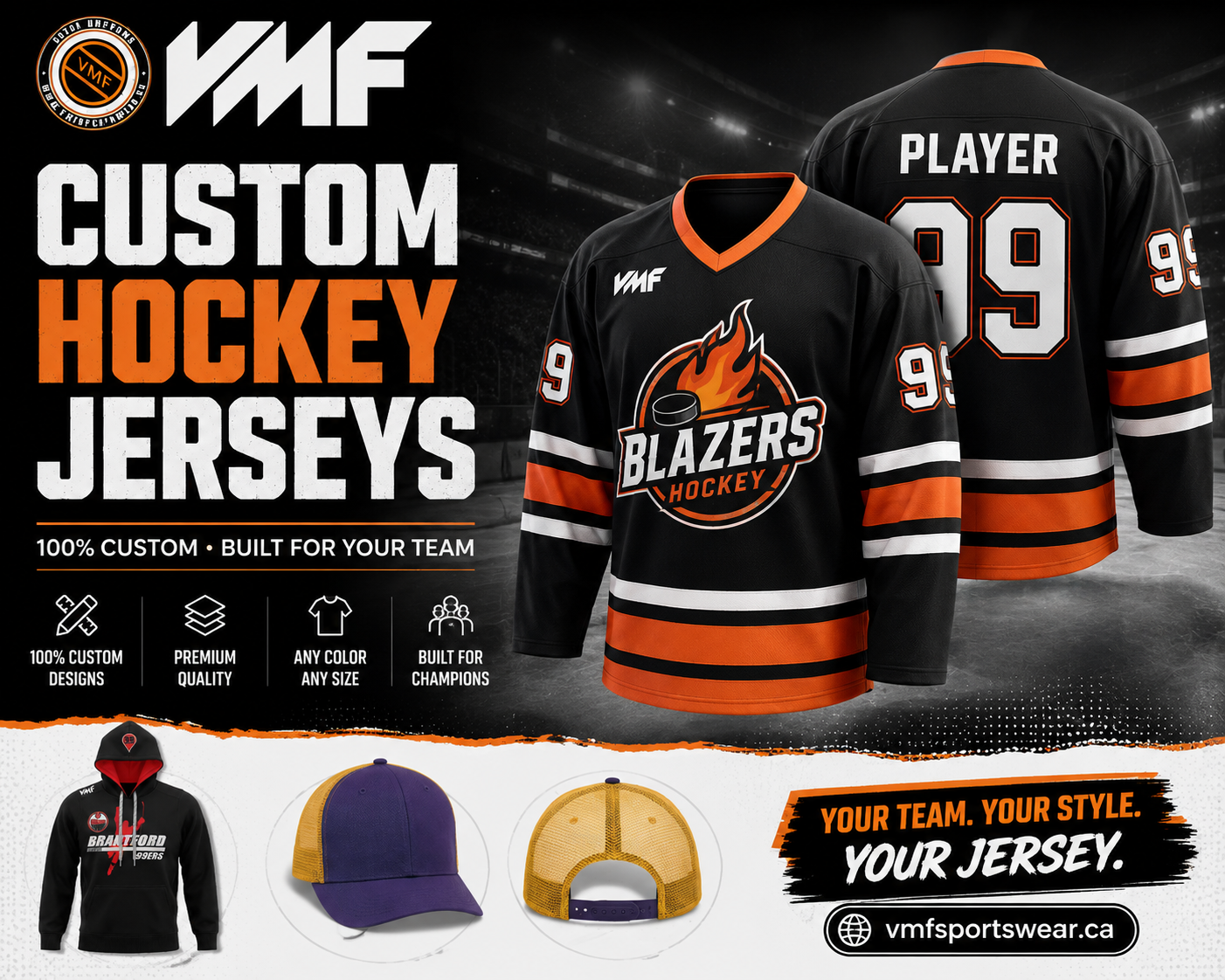
VMF Sportswear produces the complete range of custom hockey jerseys Canadian organizations need — from sublimated designs with unlimited colour and graphic freedom to pro stitched jerseys with classic competition-grade construction. Explore our full range of custom hockey jerseys to find the right option for your organization’s upcoming season.
- Sublimated hockey jerseys — vibrant, fully custom, permanently bonded designs
- Pro stitched hockey jerseys — classic, structured, competition-grade quality
- Custom player names, numbers, and embroidered crests
- Matching pant shells, socks, and gloves
- Custom hoodies, track suits, and winter jackets
- Custom bags, caps, toques, and accessories
- Bulk ordering for associations and clubs of all sizes
- Individual labelling and organized packaging by player
- Reliable domestic production and delivery across Ontario and Canada
Start Your Jersey Order Today
Contact VMF Sportswear today to begin your custom hockey jersey order. Our team guides you through every stage of the manufacturing process described in this guide — from the initial design consultation through to delivery at your door. We are ready to help your organization build jerseys that players are proud to wear from the opening game right through to the finals.
Frequently Asked Questions
VMF Sportswear recommends allowing at least six to eight weeks from design approval to delivery for custom hockey jersey orders. This timeline covers design proofing, pre-production file preparation, sublimation printing or pro stitching, garment assembly, quality inspection, individual labelling, packaging, and domestic shipping. Starting the process earlier than the minimum consistently produces better outcomes and less pre-season stress for coaches and team managers.
Sublimated jerseys bond colour and graphics permanently into the fabric fibres using heat and pressure — producing vibrant, unlimited designs that never crack, peel, or fade. Pro stitched jerseys apply sewn lettering, numbers, and embroidered crests directly to the garment fabric — producing a classic, structured look preferred by many competitive leagues. VMF Sportswear manufactures both types and can combine both methods in a single jersey order.
The design proof review is the last checkpoint before the manufacturer commits the order to production. Every error the organization catches and corrects at the proof stage costs nothing to fix. Every error that reaches production requires remaking individual items — adding significant cost and time to the order. A thorough proof review that involves all relevant stakeholders consistently prevents the most common and most expensive post-production problems.
Submit team logos and all design artwork in vector format — AI, EPS, or PDF files. Vector files scale to any production size without losing quality or sharpness. Raster files such as JPG or PNG produce blurry or pixelated results when the manufacturer scales them up for jersey production. Confirming file requirements with VMF Sportswear before submitting artwork keeps the design process moving efficiently from the very start.
Absolutely. VMF Sportswear manufactures custom hockey jerseys for organizations throughout Ontario and across Canada, with reliable domestic production timelines and shipping to all regions. We work with minor hockey associations, school programs, competitive travel teams, and recreational leagues of every size and level — managing every stage of the manufacturing process in-house from design to delivery.
Final Thought
The manufacturing process behind custom hockey jerseys involves far more than most organizations realize when they place an order. Design consultation, digital proofing, pre-production file preparation, sublimation printing or pro stitching, garment assembly, quality inspection, individual labelling, and domestic delivery all need to happen correctly and in sequence. Only then does the finished jersey meet the standard every player and organization deserves.
VMF Sportswear manages every one of those stages in-house — with the direct manufacturing control, quality commitment, and design expertise that Canadian hockey organizations depend on season after season. Contact us today to start your custom hockey jersey order and experience the manufacturing process described in this guide firsthand, from the first design consultation through to jerseys arriving at your door ready for opening night.